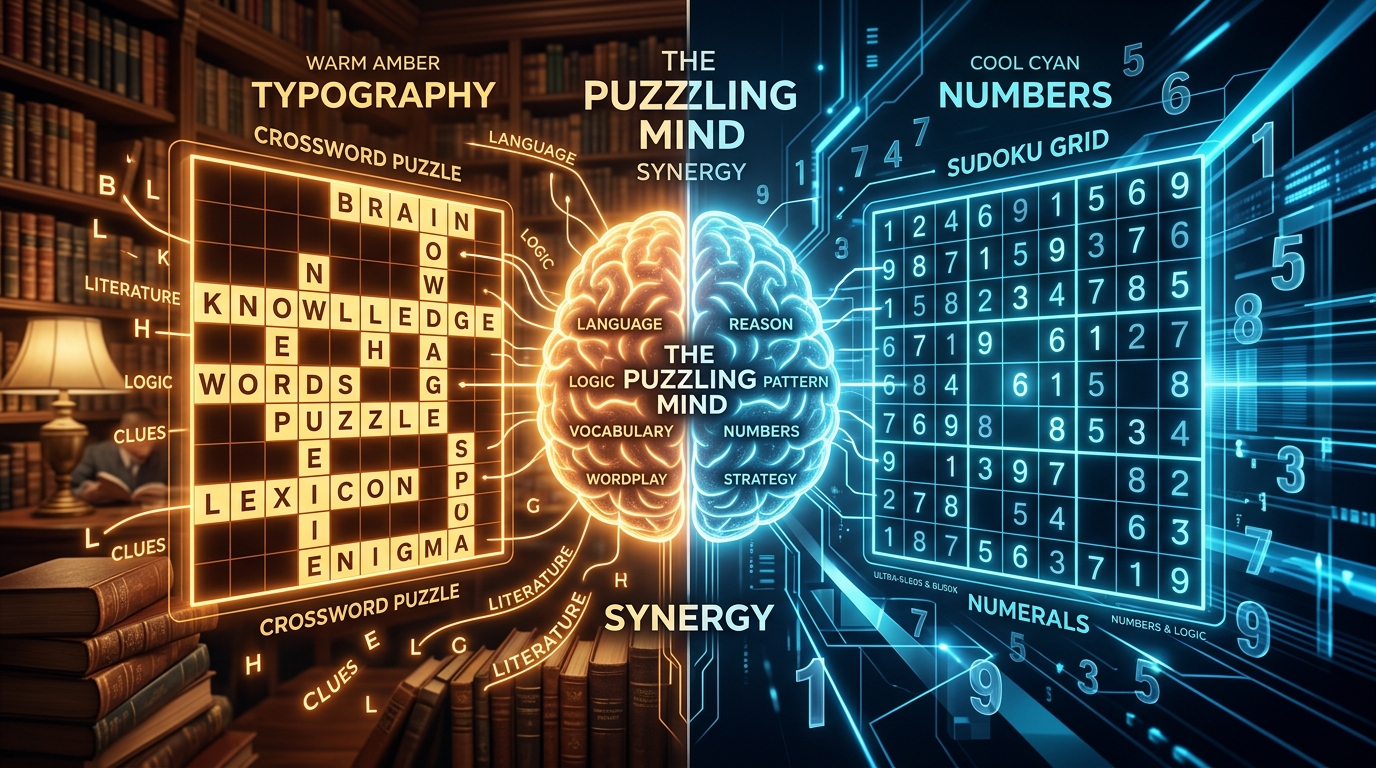
The Great Breakfast Table Rivalry
Every morning, millions of people split into two distinct philosophical camps: those who reach for the crossword puzzle with a sharpened pencil, and those who open a 9×9 Sudoku grid.
For decades, crosswords were widely accepted as the gold standard of intellectual pastime. But when Sudoku burst onto the scene in the mid-2000s, neuroscientists finally had a laboratory control to answer a fascinating question: Does the brain benefit more from organizing words or manipulating numbers?
Neural Anatomy: What Each Game Demands
The most crucial distinction between Sudoku and crosswords lies in which neural networks are recruited during play:
Crosswords: Semantic Retrieval
Crosswords operate via associative memory retrieval. When you see the clue "Ancient Greek port (7 letters)", your brain conducts a high-speed search through the left temporal lobe and Broca's/Wernicke's language areas.
- • Strengthens vocabulary and lexical agility
- • Heavy reliance on acquired crystallized memory
- • Susceptible to "tip-of-the-tongue" frustration
Sudoku: Executive Working Memory
Sudoku requires zero factual recall. Instead, it tests the prefrontal cortex's working memory scratchpad. You must hold constraints across 9 rows, 9 columns, and 9 regional blocks simultaneously.
- • Exercised by candidate elimination (pointing pairs)
- • Pure fluid logic and visuospatial mapping
- • 100% universal across all languages & cultures
Head-to-Head Comparison: Sudoku vs. Crosswords
| Dimension | Sudoku | Crossword Puzzles | Scientific Edge |
|---|---|---|---|
| Primary Brain Domain | Executive Logic & Working Memory | Semantic & Verbal Retrieval | Sudoku (Executive Focus) |
| Language & Cultural Neutrality | 100% Universal | Culture & Age-Dependent | Sudoku (Zero Trivia) |
| Stress & Flow State | High Zen Flow (Predictable Rules) | Higher Frustration (Obscure Clues) | Sudoku (Pure Logic) |
| Vocabulary Retention | None | Extremely High | Crosswords (Linguistics) |
| Dementia Delay Link | +8 to 10 Year Younger Brain | +8 to 10 Year Younger Brain | TIE (Both Proven) |
The 19,000-Person PROTECT Study
The most authoritative clinical evidence to date comes from a joint research initiative by the University of Exeter and King's College London, published in the International Journal of Geriatric Psychiatry.
Researchers tracked over 19,000 healthy adults aged 50 and older who regularly solved either word puzzles (crosswords) or number puzzles (Sudoku). The findings were astounding:
"Participants who regularly solve puzzles have brain function equivalent to ten years younger than their chronological age on tests assessing memory, attention, and executive reasoning."
When researchers examined micro-subtests, number puzzle solvers (Sudoku players) exhibited a slight statistical advantage in grammatical logic speed and spatial pattern accuracy compared to pure crossword solvers, likely due to the rigorous branch-elimination demands of harder grids.
The Optimal Prescription: Why Not Both?
Neurologists emphasize that the ultimate cognitive workout is not tribal loyalty to one game, but cross-training.
Just as an athlete does not only run sprints or only lift weights, a healthy mind benefits immensely from exercising both linguistic memory (crosswords) and spatial executive deduction (Sudoku). If you spend Monday through Wednesday testing your deductive reasoning on a Daily Sudoku Challenge, and Thursday solving a crossword, you effectively stimulate both cerebral hemispheres.
Frequently Asked Questions
Is Sudoku better than crosswords for people with anxiety?
Generally, yes. Sudoku contains strictly defined, unambiguous logical rules with no trick questions, pop-culture puns, or subjective wordplay. This predictable closed-system structure allows the amygdala to relax and promotes a meditative state.
Do I need to be good at math to play Sudoku?
Not at all! Sudoku involves zero addition, subtraction, or arithmetic. The digits 1 through 9 are simply arbitrary distinct tokens. If you can distinguish 9 different colors or letters, you can master Sudoku.