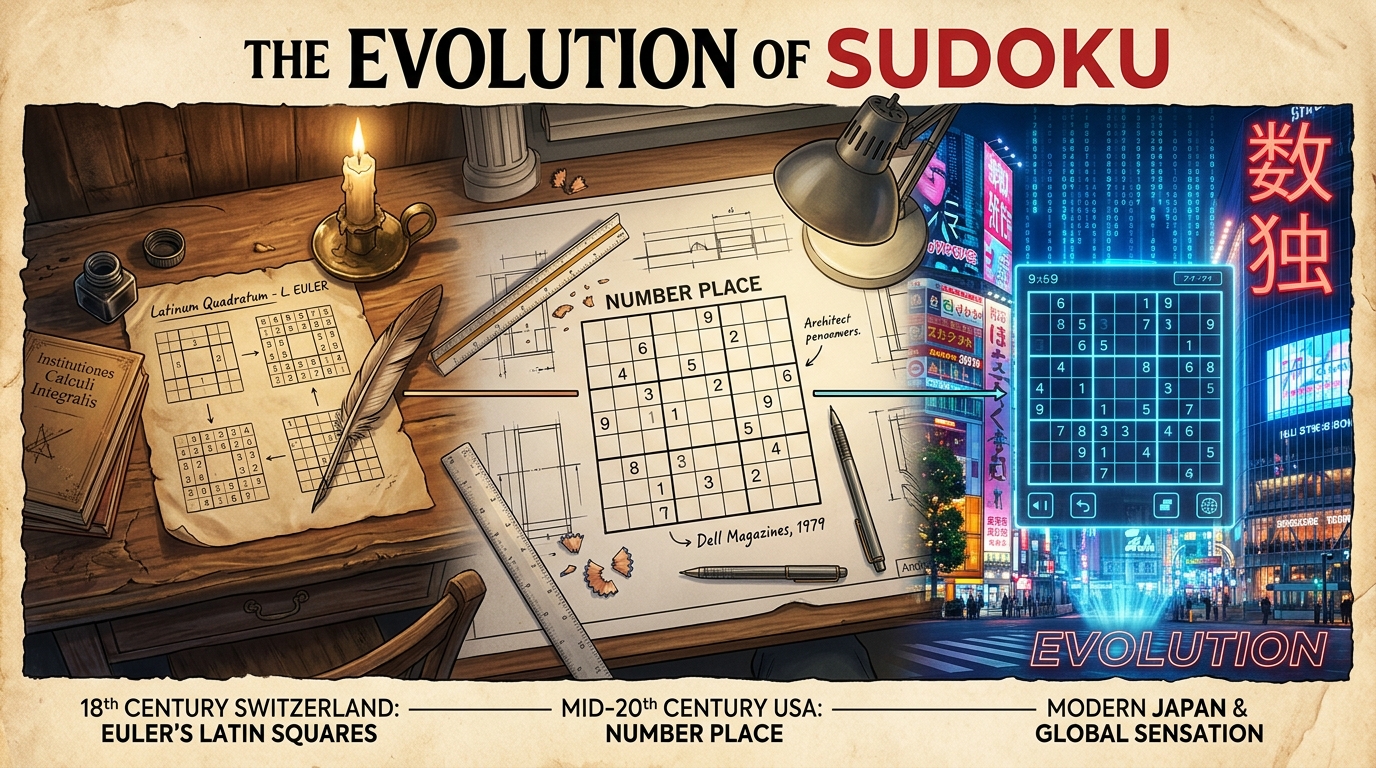
The Myth of the Ancient Japanese Origin
Ask any casual commuter solving a 9×9 grid on their smartphone where Sudoku comes from, and nine out of ten will tell you it is an ancient Japanese meditation exercise dating back to the samurai or Edo period.
The reality is far more international, delightfully chaotic, and intimately tied to western architectural blueprints, Swiss calculus, and British newspaper print wars. While Japan undoubtedly gave the game its immortal name and artisanal soul, the mathematical architecture of Sudoku was born on the drawing boards of North America and Europe.
1783: Leonhard Euler and the Magic of Latin Squares
The earliest ancestor of the puzzle can be traced to Basel, Switzerland, and the brilliant mind of Leonhard Euler (1707–1783). While studying combinatorial probability and recreational mathematics during his final years, Euler investigated an abstract grid structure known as a Carré latin, or Latin Square.
An n × n Latin Square is an array filled with n distinct symbols such that each symbol occurs exactly once in each row and exactly once in each column. Euler was not interested in entertaining commuters on the tube; he was laying theoretical groundwork for experimental design and orthogonal matrices.
1979: Howard Garns and "Number Place"
The true father of modern Sudoku was an unassuming 74-year-old retired architect from Connersville, Indiana: Howard S. Garns.
During the late 1970s, Garns spent his quiet retirement tinkering with draft sketches. He realized that if you took a 9×9 Latin square, superimposed a secondary 3×3 regional grid, and carefully deleted numbers until only a single unique solution remained, you created a breathtakingly pure puzzle of deductive elimination.
In May 1979, Dell Magazines published Garns’ invention in Dell Pencil Puzzles and Word Games under the utilitarian title "Number Place". Sadly, Garns never saw his creation achieve global stardom: he passed away in 1989 from cancer, having never patented the design or earned royalties from the billions of puzzles solved in his wake.
1984: Maki Kaji and the Nikoli Revolution
In April 1984, the puzzle crossed the Pacific Ocean into the hands of Maki Kaji, the charismatic founder of the Japanese puzzle magazine publisher Nikoli.
Kaji was mesmerized by Number Place, but found the American name dull and clinical. He wanted a title that conveyed the monastic, poetic nature of the rules. Walking through a Tokyo train station, the phrase struck him:
"Sūji wa dokushin ni kagiru" (数字は独身に限る) — literally: The digits must remain unmarried (single).
Kaji quickly abbreviated the phrase to Sū-Doku (数独 — Sū = Number, Doku = Single). Furthermore, Nikoli introduced two sacred editorial design rules that elevated Sudoku from a generic grid into high art:
- Rotational Symmetry: The starting clues given on the board must form an aesthetically pleasing, symmetrical pattern (usually 180-degree rotational symmetry) when viewed upside-down.
- The 32-Clue Ceiling: Hand-crafted puzzles should provide no more than 30 to 32 clues, challenging the solver's pure logic rather than testing clerical endurance.
2004: Wayne Gould and The Times Newspaper Craze
Despite booming popularity in Japan throughout the 1990s, the Western world remained oblivious until 1997, when a retired New Zealand judge named Wayne Gould walked into a Tokyo bookstore during a vacation.
Although unable to read Japanese, Gould immediately recognized the mathematical genius of the 9×9 grid. An amateur computer hobbyist, Gould spent the next six years writing a complex C++ program capable of generating infinite unique Sudoku puzzles rated by logical difficulty.
In late 2004, Gould convinced the editors of Britain's most prestigious broadsheet newspaper, The Times (London), to publish a daily puzzle. The response was unprecedented: commuter trains across the United Kingdom fell silent as millions abandoned traditional crosswords to solve rows of numbers. Within six months, every major newspaper from The New York Times to The Sydney Morning Herald had launched dedicated Sudoku syndications.
Chronological Evolution of Sudoku
| Year | Key Figure | Original Name | Core Contribution |
|---|---|---|---|
| 1783 | Leonhard Euler | Latin Square | Formulated the mathematical row/column uniqueness constraint. |
| 1979 | Howard Garns | Number Place | Added the 3×3 regional box constraint and empty cell deletion logic. |
| 1984 | Maki Kaji | Sudoku | Coined the name "Sudoku" and codified rotational symmetry standards. |
| 2000 | Donald Knuth | Algorithm X (DLX) | Discovered dancing links exact-cover algorithm to verify uniqueness in milliseconds. |
| 2004 | Wayne Gould | The Times Sudoku | Syndicated computer-generated logic grids into global mainstream media. |
The Web Era: From Flash Games to Modern Web Apps (2000–Present)
Following the 2004 newspaper boom, the battleground for Sudoku moved swiftly from newsprint to the early World Wide Web. In 2005, pioneering internet developers launched first-generation browser portals such as Web Sudoku (founded by Gideon Greenspan) and casual portal networks like 247 Sudoku. For the first time, players could solve millions of automated puzzles without purchasing physical paper booklets.
As newspapers faced digital disruption, prestigious publications also adapted. The New York Times (NYT Sudoku) integrated digital daily logic puzzles directly into its NYT Games subscription umbrella, establishing a beloved daily ritual for millions of global subscribers alongside the Crossword and Wordle.
However, early web implementations suffered from heavy Flash dependencies, cluttered banner ads, and primitive puzzle generators that occasionally produced ambiguous boards. Today, the third generation of web Sudoku has arrived: modern progressive web apps powered by instant Dancing Links (DLX) logic, offline capabilities, zero intrusive popups, and distraction-free typography.
The Modern Era: From Newsprint to Dancing Links (DLX)
Today, Sudoku has transcended physical paper. With the advent of computational graph theory, computer scientists such as Stanford professor Donald Knuth revealed that Sudoku is formally an exact cover problem, solvable instantaneously using doubly linked circular lists known as Dancing Links (Algorithm X).
At Sudoku Pro, we utilize this exact algorithmic legacy. Every puzzle generated in our Easy, Hard, and Evil tiers is tested through Knuth's DLX engine to guarantee zero ambiguity, mathematical elegance, and strictly one unique solution.
Frequently Asked Questions About Sudoku History
Who actually invented Sudoku first?
The modern 9×9 grid with 3×3 regional subgrids was invented by American architect Howard S. Garns and published in 1979 as "Number Place". Swiss mathematician Leonhard Euler invented the underlying Latin Square math in 1783, while Maki Kaji branded and popularized it as "Sudoku" in 1984.
What does the word "Sudoku" literally mean in Japanese?
"Sudoku" (数独) is a contraction of the Japanese phrase "Sūji wa dokushin ni kagiru", meaning "the numbers must occur only once" or "digits must remain single/unmarried".
Why did Sudoku become more popular than crossword puzzles?
Sudoku requires zero cultural, linguistic, or vocabulary knowledge. A player in Tokyo, Berlin, or New York solves using the exact same universal rules of pure deductive logic, making it the first truly borderless global mind game.