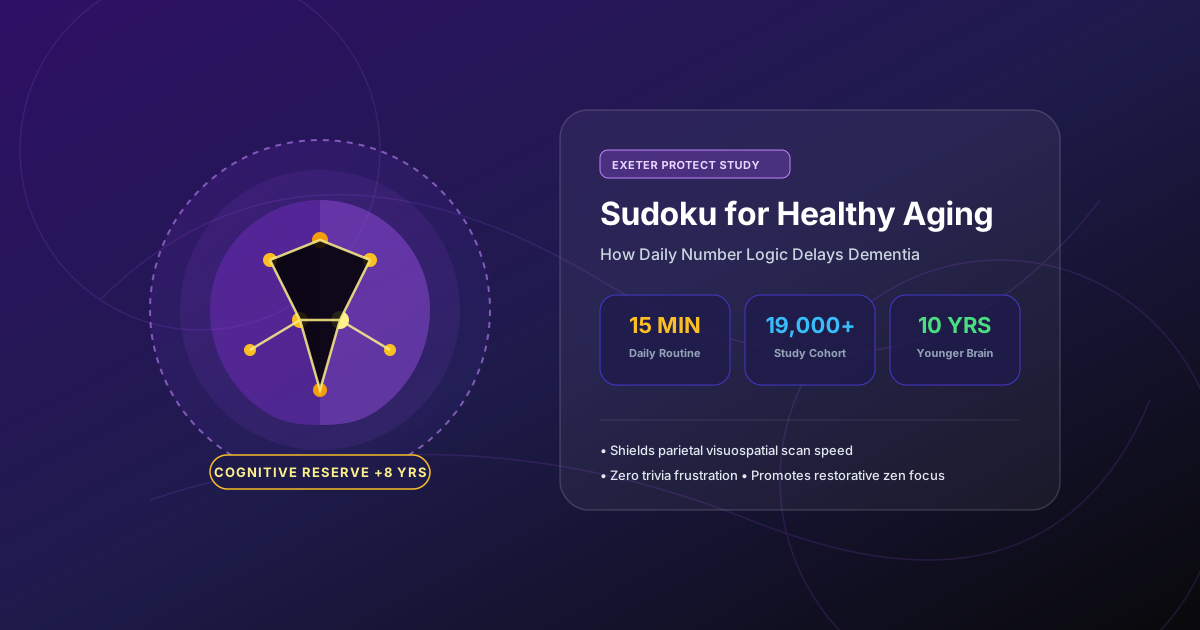
The Aging Brain: A Battle Against Synaptic Pruning
As we cross into our 60s and 70s, our brains naturally undergo structural changes. Cerebral blood flow decreases, white matter integrity diminishes, and synaptic connections in the hippocampus and frontal cortex begin to thin.
For decades, senile dementia was regarded as an inevitable biological decay. Today, modern neurobiology knows better: the human brain retains lifelong neuroplasticity—the remarkable ability to sprout new dendritic spines and reconfigure neural circuits well into our 80s and 90s.
Among the non-pharmacological interventions studied by memory clinics, Sudoku has emerged as one of the most cost-effective, accessible, and intellectually stimulating tools for preserving senior cognition.
Understanding the "Cognitive Reserve" Hypothesis
Pioneered by Dr. Yaakov Stern at Columbia University Medical Center, the Cognitive Reserve theory explains a fascinating paradox that baffled pathologists for generations:
In post-mortem autopsies, researchers frequently discover elderly individuals whose brains were riddled with the classic neurofibrillary tangles of Alzheimer's disease—yet throughout their living lives, they exhibited zero noticeable memory impairment.
How was this possible? Because these individuals possessed high Cognitive Reserve. By constantly challenging their brains with demanding problem-solving—such as mathematics, musical instruments, chess, or Medium Sudoku—they built a vast web of interconnected neurological detour routes. When Alzheimer's pathology destroyed one pathway, their brain simply routed the thought through an adjacent redundant circuit.
The Specific Cognitive Muscles Sudoku Exercises in Seniors
Sudoku is unique among retirement pastimes because it demands coordinated collaboration across several declining cognitive faculties:
1. Visuospatial Scanning and Attention Control
Tracking numbers across an 81-cell matrix activates the parietal lobe, combating age-related tunnel vision and preserving rapid visual search capabilities crucial for safe driving.
2. Short-Term Working Memory
Holding the thought "Box 3 already contains 4, 7, and 9" while evaluating Row 2 forces the dorsolateral prefrontal cortex to retain active data buffers, directly countering short-term forgetfulness.
3. Deductive Decision-Making Without Frustration
Unlike crossword puzzles, which can trigger distress when historical trivia or unfamiliar modern slang cannot be recalled, Sudoku is self-contained. Every piece of information required to solve the grid is already present on the page.
Recommended Routine for Seniors & Caregivers
To reap the neuroprotective benefits of Sudoku without causing undue eye strain or cognitive burnout, geriatric health professionals advise following this 3-step protocol:
- Start at the Right Threshold: Never force an older adult or beginner to start on Hard. Begin with our Easy Sudoku puzzles. Success fosters self-efficacy and triggers dopamine; excessive difficulty triggers cortisol.
- Use Large Print or High Contrast UI: If solving physically, print out our high-contrast Printable Sudoku PDF sheets with generous margins and extra-large numerals. If solving online, use our built-in Dark Mode or large cell touch targets on an iPad.
- Consistency Over Duration: Solving one 15-minute puzzle every single morning with breakfast is vastly superior to solving for two hours once a week. Consistency reinforces circadian cognitive rhythms.
Frequently Asked Questions
Can Sudoku reverse existing Alzheimer's disease?
No medical puzzle or lifestyle intervention can cure or reverse established Alzheimer's pathology. However, clinical studies prove it can significantly delay the onset of clinical symptoms and help seniors retain functional independence for years longer.
Is physical paper better for seniors than playing on a computer or tablet?
Both offer distinct advantages. Physical paper eliminates digital glare and promotes tactile fine-motor finger dexterity. Conversely, modern web apps like iLoveSudoku offer instant error highlighting, undo buttons, and pencil note auto-checks that prevent seniors from becoming frustrated by manual pen erasures.